
Communications secured by physics.
SuperQubit develops the software layer that brings Quantum Key Distribution into operational telecommunication — across the classical networks that already carry the world’s traffic.
Authentication anchored in post-quantum cryptography. Keys distributed by physics. Two operating modes, from high-bandwidth symmetric encryption to information-theoretically secure transmission.
Today's secure channels were not built for tomorrow's adversary.
Public-key cryptography — the foundation of every secure connection in use today — rests on mathematical problems that a sufficiently capable quantum computer will solve. Data collected and stored now can be decrypted later. The threat is not theoretical, and it does not announce its arrival.
Quantum Key Distribution offers a different foundation entirely: shared key material whose secrecy is guaranteed by the laws of physics rather than by computational hardness. The technology exists. What has been missing is the software layer that makes it usable — at scale, across heterogeneous networks, by applications that weren’t written with QKD in mind.
Most QKD deployments today stop at a 256-bit shared key feeding AES. It is a meaningful improvement over public-key exchange — and a long way from what the underlying physics can actually deliver.
From quantum-safe today, to information-theoretic tomorrow.
Symmetric Mode
QKD distributes a fresh symmetric key, periodically refreshed, between the two endpoints. The key seeds AES-256 (or other certified symmetric ciphers) for the actual data encryption. The result: high-bandwidth quantum-safe channels suitable for general enterprise and operator traffic.
Compatible with existing high-throughput workloads. Aligned with ETSI QKD standards. Ready for deployment today.
256 bits
Gbps-class
Information-theoretic Mode
QKD distributes key material equal in length to the message itself. The encryption is unconditionally secure against any adversary with any amount of computational power — quantum, classical, etc — for the universe’s lifetime.
Reserved for the traffic where assurance must exceed the lifetime of any cryptographic assumption: command-and-control channels, financial settlement, classified message exchange, key control planes.
Variable
Bounded
Our software supports two distinct cryptographic regimes — selected by policy, by workload, and by the assurance level the channel requires.
Software above QKD. Classical networks below. Applications unchanged.
Our software sits between your applications and the QKD hardware you choose, and the encrypted traffic travels over the classical networks you already run. Endpoints authenticate using post-quantum algorithms. Keys are consumed under policy. Traffic is delivered intact at the peer.
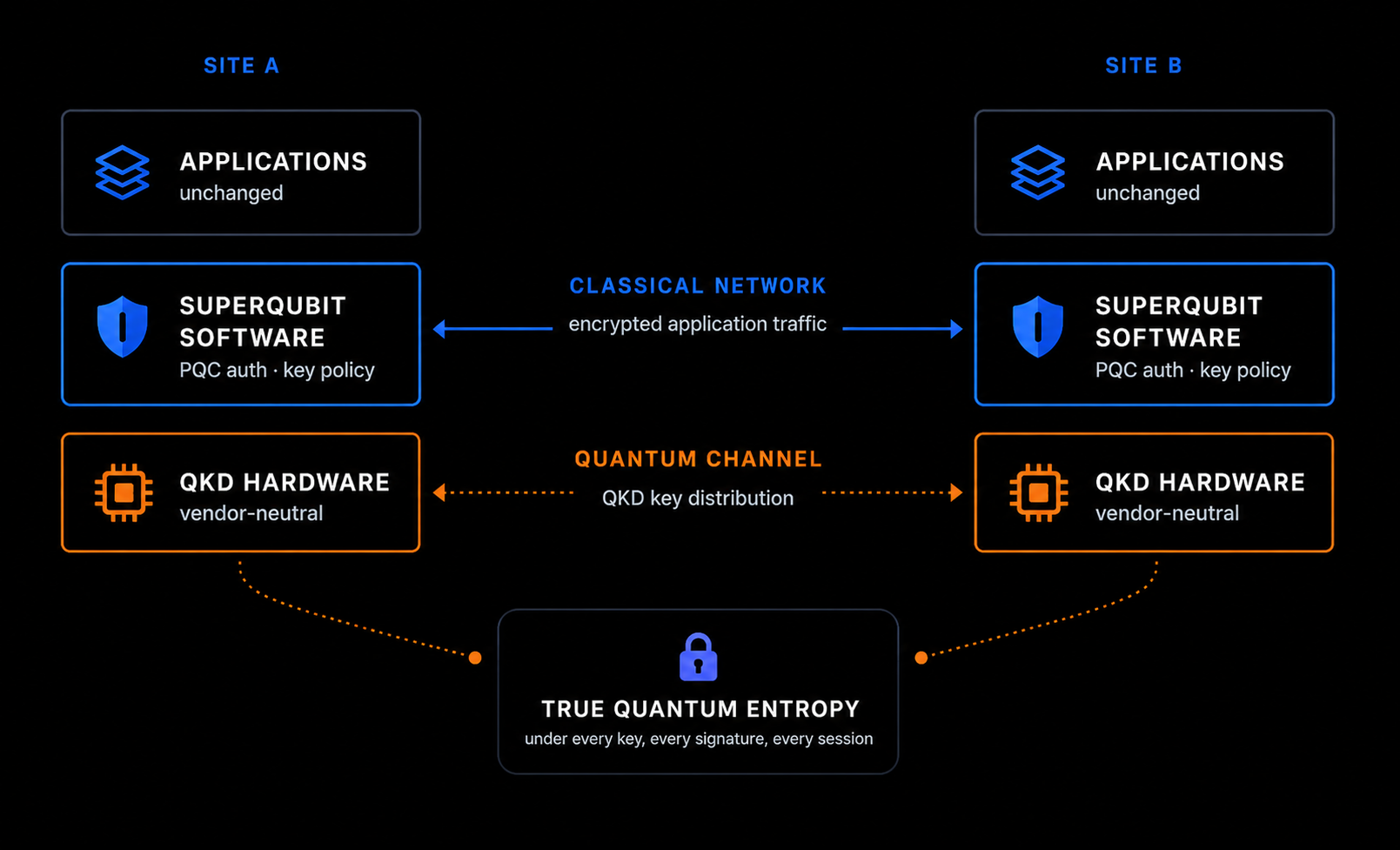
Quantum keys travel one path. Application data travels another. Both ends authenticate post-quantum.
Built for the realities of operational networks.
Vendor-neutral by design.
Integrates with QKD hardware from multiple vendors through standards-aligned interfaces, so your hardware choices remain yours. No lock-in. Upgrade hardware independently of software.
Runs over classical networks.
Encrypted application traffic traverses the IP networks you already operate. Only the quantum channel requires QKD-capable links. Existing networks become quantum-secured without rebuild.
Post-quantum authentication.
Endpoint authentication and message integrity use NIST-standardized post-quantum algorithms — closing the authentication gap that pure QKD leaves open.
Policy-driven key consumption.
Operators control how QKD-generated key material is allocated across channels, applications, and operating modes — by traffic class, by sensitivity, by service-level policy.
Hybrid with classical encryption.
Quantum-secured channels can be layered with additional classical or post-quantum encryption for defense in depth, regulatory alignment, and graceful degradation when QKD links are unavailable.
True quantum entropy under every key.
Authentication keys, session parameters, and policy material are seeded by genuine quantum randomness — not pseudorandom approximation. The cryptographic foundation matches the physical one.
Beyond the conventional QKD deployment.
Most QKD implementations stop at symmetric-key delivery to a network encryptor. Our software extends QKD into a complete telecommunications layer — with two operating modes, post-quantum authentication, and policy control across heterogeneous infrastructure.
| CAPABILITY | CONVENTIONAL QKD ENCRYPTOR | SUPERQUBIT SOFTWARE |
|---|---|---|
| QKD-distributed key feeding symmetric encryption | Yes | Yes (Mode 01) |
| Information-theoretically secure transmission | No | Yes (Mode 02) |
| Post-quantum endpoint authentication | Typically pre-shared | Built-in |
| Vendor-neutral QKD hardware support | Usually vendor-specific | Standards-aligned |
| Operates over existing classical networks | Yes | Yes |
| Policy-driven key allocation across flows | Limited | Full operator control |
| True quantum entropy under every key | Depends on integration | Foundational |
Our position
Most QKD systems stop at a shared key. We don't. The full promise of the physics belongs in production.
Built for the channels where assurance is non-negotiable.
Information-theoretic mode is bounded by QKD key supply, so we direct it where it earns its bit budget — the traffic for which any cryptographic assumption is one too many.
Inter-site classified links.
Command-and-control, diplomatic communication, classified message exchange — channels that must remain secure against adversaries with unknown computational futures.
Operator control planes.
Power grid, telecom backbone, and financial settlement networks — the control traffic that, if compromised retroactively, cascades through every system that depends on it.
Settlements & Reserves.
Inter-bank settlement, central-bank communication, and high-value trade authorization — where decades-long data confidentiality is a regulatory and reputational requirement.
Designing a network where tomorrow's adversary matters?
Talk directly to our engineering team.
We respond personally, and we respond quickly.